Patron saints are chosen as special protectors or guardians over areas of life. These areas can include occupations, illnesses, churches, countries, causes -- anything that is important to us. The earliest records show that people and churches were named after apostles and martyrs as early as the fourth century. Recently, the popes have named patron saints but patrons can be chosen by other individuals or groups as well. Patron saints are often chosen today because an interest, talent, or event in their lives overlaps with the special area. For example, Francis of Assisi loved nature and so he is patron of ecologists. Francis de Sales was a writer and so he is patron of journalists and writers. Clare of Assisi was named patron of television because one Christmas when she was too ill to leave her bed she saw and heard Christmas Mass -- even though it was taking place miles away. Angels can also be named as patron saints.A patron saint can help us when we follow the example of that saint's life and when we ask for that saint's intercessory prayers to God.

St.Augusitine writing Confessions
While remembering all his youthful follies, he remembers how God's unfarthomable grace has been a shield for him, how grace leads to discover his faith into Three in One God.

Divine Illumination
St: Augustine receive divine illumination from Jesus the Son of God and Mary, the mother of Jesus, enlightening him while he is writing his discourse.
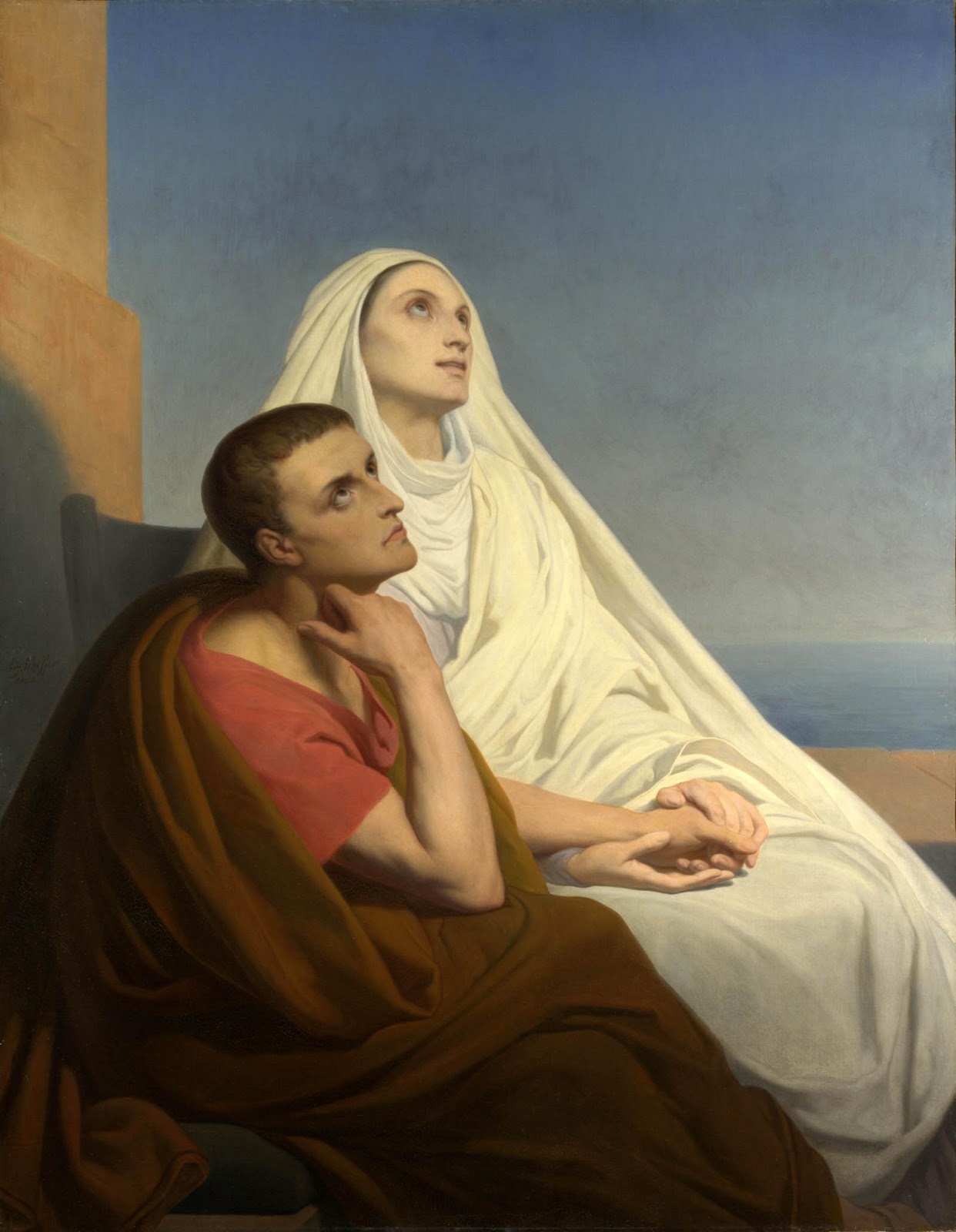
St.MONICA and St.AUGUSTINE at Ecstacy at Ostia
Two saints, mother and son receive a vision of heaven at Ostia, near Rome. It was the last moment of the two being together, looking heaven ward, and later St.Monica died and was buried there.

Seminarians on the wall.
With co-seminarians, where trying to escape the scourging sunlight, sitting on the fence and keeping ourselves calm with jokes.

Rosary Garden at Tabor Hill, Talamban
A place of prayer and peace, a place of love and charity where being together with the mother of our Divine Lord, and recitation of Holy Rosary knocks the doors of Heaven.
16 April, 2011
15 April, 2011
Do Catholics pray TO saints?
We pray with saints, not to them.
Have you ever asked anyone to pray for you when you were having a hard time? Why did you choose to ask that person?
You may have chosen someone you could trust, or someone who understood your problem, or someone who was close to God. Those are all reasons we ask saints to pray for us in times of trouble.
Since saints led holy lives and are close to God in heaven, we feel that their prayers are particularly effective. Often we ask particular saints to pray for us if we feel they have a particular interest in our problem. For example, many people ask Saint Monica to pray for them if they have trouble with unanswered prayers, because Monica prayed for twenty years for her son to be converted. Finally her prayers were answered in a way she never dreamed of -- her son, Augustine, became a canonized saint and a Doctor of the Church.
14 April, 2011
Is keeping statues or pictures of saints idolatry?
Look at the pictures of your loved ones in your wallet or around your home or office. Why do you keep these particular pictures? You might answer that you carry those pictures to remind you of people you love, to help you feel that they're close to you when you're not together, or to share with people you meet. But you probably didn't say you worshipped them. Those are some of the same reasons we have statues and pictures of saints. Seeing a statue of Saint Therese of Lisieux who lost her mother when she was a child might make us feel less alone when we are grieving. A picture of Saint Francis of Assisi might remind us of how much he loved God's creation and make us more aware of our environment.
13 April, 2011
Options for the Washing of Feet
ROME, APRIL 12, 2011 (Zenit.org).- Answered by Legionary of Christ Father Edward McNamara, professor of liturgy at the Regina Apostolorum university. Q: What is a priest, in a one-priest parish, to do on Holy Thursday when he cannot kneel down for the Washing of Feet? What are the options? -- J.K., Opelika, Alabama
A: This is probably going to be an increasing difficulty for many priests in the coming years.
The first, and simplest, option is to omit the rite altogether. Although many are unaware of the fact, the Washing of Feet is an optional rite. The rubrics of the Mass of the Lord's Supper say, "Depending on pastoral circumstances, the washing of feet may follow the homily." Certainly, at times it seems that, in liturgy, nothing is more obligatory than an option. But in this case if the priest is no longer physically up to handling the Washing of Feet, then he may leave it out.
If he is loath to forgo the Washing of Feet, given the pastoral value of this once-a-year rite, it is possible to set things up so that those whose feet are to be washed sit on an elevated base so as to be more readily accessible to the priest. This was the system adopted by Pope John Paul II in the latter years of his pontificate when Parkinson's disease impeded his kneeling and bending over.
If setting up an elevated base for 12 people is too complicated, then the number can be reduced to fit the space. They could also rotate by two's or three's after their feet have been washed, provided that the process can be carried out with pause and decorum.
As a rule the men whose feet are to be washed should be advised ahead of time; this is especially required when the celebrant has some physical difficulty. A practice session before Mass can be very helpful in ensuring that the rite runs smoothly and with the dignity and solemnity required by the moment and importance of the celebration.
* * *
Readers may send questions to liturgy@zenit.org. Please put the word "Liturgy" in the subject field. The text should include your initials, your city and your state, province or country. Father McNamara can only answer a small selection of the great number of questions that arrive.
A: This is probably going to be an increasing difficulty for many priests in the coming years.
The first, and simplest, option is to omit the rite altogether. Although many are unaware of the fact, the Washing of Feet is an optional rite. The rubrics of the Mass of the Lord's Supper say, "Depending on pastoral circumstances, the washing of feet may follow the homily." Certainly, at times it seems that, in liturgy, nothing is more obligatory than an option. But in this case if the priest is no longer physically up to handling the Washing of Feet, then he may leave it out.
If he is loath to forgo the Washing of Feet, given the pastoral value of this once-a-year rite, it is possible to set things up so that those whose feet are to be washed sit on an elevated base so as to be more readily accessible to the priest. This was the system adopted by Pope John Paul II in the latter years of his pontificate when Parkinson's disease impeded his kneeling and bending over.
If setting up an elevated base for 12 people is too complicated, then the number can be reduced to fit the space. They could also rotate by two's or three's after their feet have been washed, provided that the process can be carried out with pause and decorum.
As a rule the men whose feet are to be washed should be advised ahead of time; this is especially required when the celebrant has some physical difficulty. A practice session before Mass can be very helpful in ensuring that the rite runs smoothly and with the dignity and solemnity required by the moment and importance of the celebration.
* * *
Readers may send questions to liturgy@zenit.org. Please put the word "Liturgy" in the subject field. The text should include your initials, your city and your state, province or country. Father McNamara can only answer a small selection of the great number of questions that arrive.
When did the Church start honoring saints?
By the year 100 A.D., Christians were honoring other Christians who had died, and asking for their intercession. Many people think that honoring saints was something the Church set up later, but it was part of Christianity from the very beginning. As a matter of fact, this practice came from a long-standing tradition in the Jewish faith of honoring prophets and holy people with shrines. The first saints were martyrs, people who had given up their lives for the Faith in the persecution of Christians.
12 April, 2011
All About Saints

Exactly how many saints are there?
There are over 10,000 named saints and beati from history, the Roman Martyology and Orthodox sources, but no definitive "head count".
How does the Church choose saints?
Canonization, the process the Church uses to name a saint, has only been used since the tenth century. For hundreds of years, starting with the first martyrs of the early Church, saints were chosen by public acclaim. Though this was a more democratic way to recognize saints, some saints' stories were distorted by legend and some never existed. Gradually, the bishops and finally the Vatican took over authority for approving saints.
In 1983, Pope John Paul II made sweeping changes in the canonization procedure. The process begins after the death of a Catholic whom people regard as holy. Often, the process starts many years after death in order give perspective on the candidate. The local bishop investigates the candidate's life and writings for heroic virtue (or martyrdom) and orthodoxy of doctrine. Then a panel of theologians at the Vatican evaluates the candidate. After approval by the panel and cardinals of the Congregation for the Causes of Saints, the pope proclaims the candidate "venerable."
The next step, beatification, requires evidence of one miracle (except in the case of martyrs). Since miracles are considered proof that the person is in heaven and can intercede for us, the miracle must take place after the candidate's death and as a result of a specific petition to the candidate. When the pope proclaims the candidate beatified or "blessed," the person can be venerated by a particular region or group of people with whom the person holds special importance.
Only after one more miracle will the pope canonize the saint (this includes martyrs as well). The title of saint tells us that the person lived a holy life, is in heaven, and is to be honored by the universal Church. Canonization does not "make" a person a saint; it recognizes what God has already done.
Though canonization is infallible and irrevocable, it takes a long time and a lot of effort. So while every person who is canonized is a saint, not every holy person has been canonized. You have probably known many "saints" in your life, and you are called by God to be one yourself.

